
Ball coupling elements
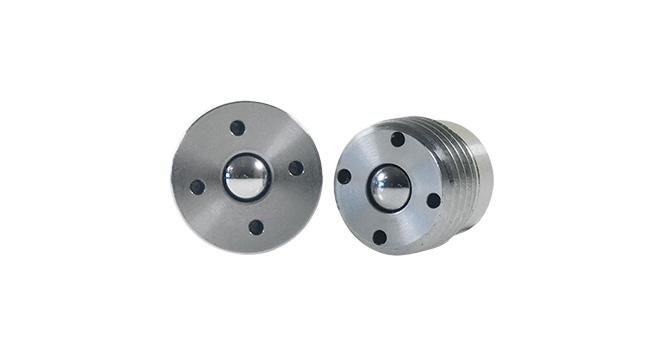
The ball coupling elements are used in tight installation situations with low coupling intervals. In cases with long coupling intervals, our standard couplings (see DB 100-3) are preferable as, unlike the ball coupling elements, they do not produce any leakage oil when uncoupling.
The coupling process must be carried out "depressurized", as the tightness of the system is only guaranteed when the system seal is in place. However, pressurization is possible in the uncoupled state.
Special features:
- Stainless materials
- Ideal for space-saving installation in individual housings
- for transferring liquid/gaseous media and vacuum
- Sealing with ball
- flat profile
- Due to the front contour, these couplings are easy to clean and malfunctions caused by dirt are minimal
- Low dirt ingress due to system sealing
| Nominal diameter: | 3 |
|---|---|
| Operating pressure: | pmax. 350 bar |
| Flow rate: | 5 l/minute |
| Dome stroke: | 1 mm |
| Coupling force: | At least 83.6 N (at 0 bar) |
| Variant: | Screw-in variants |
| Coupling method: | unpressurized |
| Medium | liquid, gaseous |
| axial coupling force under pressure per coupling point | F [N] = 26 x p [bar] |
Functional principle:
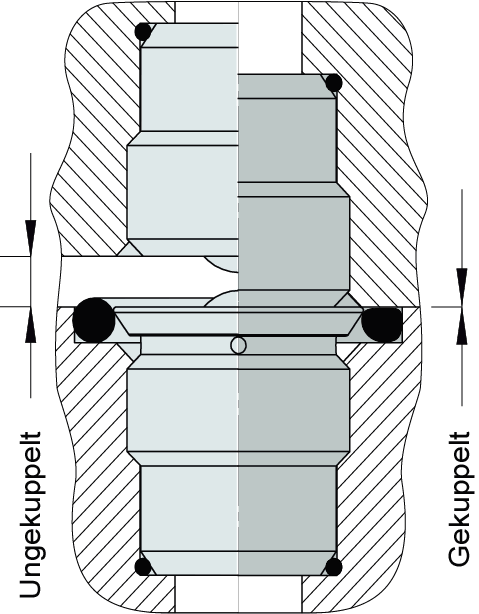
The ball coupling nipple and coupling mechanism are coaxially opposite each other before the coupling process. The receiving bodies of both coupling elements must be guided approx. 0-1 mm before the two balls come into contact, without exceeding the radial position tolerance.
If the coupling nipple and coupling mechanism are coupled together and are under pressure, a coupling force acts between them. This force must be absorbed externally in a force-fit or form-fit manner.
The axial seal on the end face with an O-ring protects the system from contamination. However, care must be taken to ensure that the end faces do not become dirty when uncoupled. This could be achieved by rinsing or blowing off with air.